
BTC's Evolving Distribution
The Daily Crypto Update for Institutional Investors

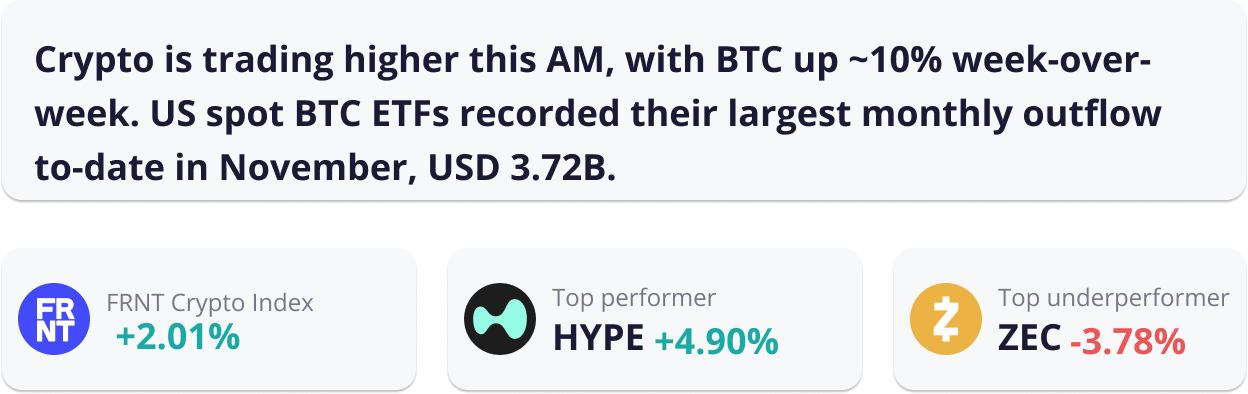

The proportion of BTC’s supply on exchanges has reached its lowest level since November 2018, a dynamic underscoring an evolving BTC market - Nevertheless, individual holders continue to hold the largest proportion of the asset’s supply, 65.9% according to estimates
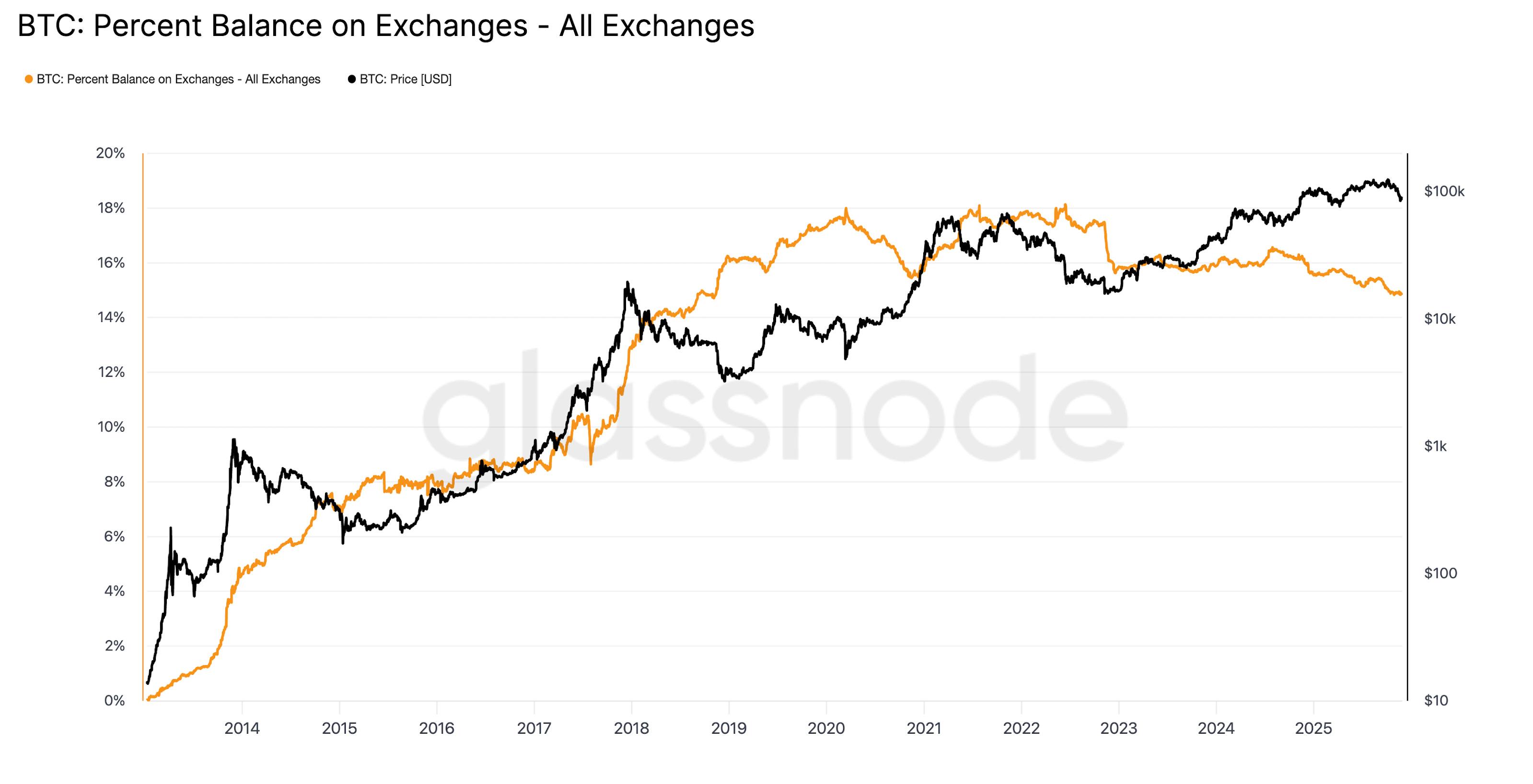
According to data from Glassnode, which tracks 27 of the leading crypto exchanges, these venues collectively hold just under 15% of BTC’s total supply. Since BTC’s earliest days, circa 2013, this metric rose from below 1% to ~18% in March 2020. This seven year period was characterized by the emergence of more robust crypto trading venues like Coinbase (NASDAQ: COIN) and Bitfinex, both founded in 2012, and Binance, founded in 2017. During the 2020 crypto bear market this metric retracted to ~15.50% before rising to record highs during the 2021/2022 bull market.
The metric saw a dramatic decline, by ~2%, in the wake of the FTX collapse as crypto traders pulled assets from venues over solvency concerns. Google searches for ‘ledger wallet’ reached a record high as the advantages of self-custody were underscored following the collapse. As counterparty anxiety in the crypto space dissipated, the metric rebounded but then continued to decline since July 2024.
The proportion of BTC held on exchanges has fluctuated over the past decade due to a number of factors, including solvency fears, profit taking, and the proliferation of self-custody. However, over the past ~1.5 years the metric has increasingly been impacted by a new cohort of BTC investors. Global public traded companies now hold 5.32% of the asset’s supply, up from 2.60% one year ago. Additionally, US BTC ETFs have accumulated 6.56% of the asset’s supply since launching in January 2024. Earlier this month, we described ‘a new investor type embracing the asset,’ pointing to allocations to BTC by actors such as the Czech National Bank (CNB) and the Harvard Endowment. These allocations, along with headlines such as JPMorgan Chase (NYSE: JPM) introducing a structured note linked to BlackRock’s BTC ETF (NASDAQ: IBIT), underscore the distribution of BTC’s supply to actors that had never previously held the asset.
Despite this redistribution of BTC due to the asset’s growing integration with the traditional global economy, estimates indicated individuals continue to hold the vast majority of the asset’s supply. For instance, according to recent research from Bitwise, individuals hold 65.9% of BTC.
Takeaway: There are numerous angles from which to analyze BTC’s distribution. Firstly, the data underscores the earliness of institutional BTC adoption. While examples such as the CNB and the Harvard Endowment highlight a ‘new investor type embracing the asset,’ in earnest these allocations represent small redistributions of BTC’s supply. Additionally, the heavy skew of BTC ownership towards individuals supports the asset’s ‘safe haven’ qualities, with no single actor positioned to exercise outsized influence over the asset’s circulating supply. Finally, the distribution highlights that the benefits of BTC price appreciation will continue to accrue mostly to individual holders.
CRYPTO HEADLINES
The UK has proposed a new tax framework that would defer capital gains taxes for DeFi lending and liquidity pool users until their underlying tokens are sold. HMRC’s approach is described as aligning tax treatment with economic reality, but the policy has not been finalized. - link - @Cointelegraph
KuCoin EU has received a MiCA license from Austria’s Financial Market Authority, enabling it to operate in 29 European Economic Area countries, excluding Malta. This authorization follows KuCoin’s application in early 2025 and aligns with its compliance strategy. - link - @CoinTelegraph
Switzerland will embed the Crypto-Asset Reporting Framework (CARF) into law on January 1, 2026, but will delay implementation of automatic crypto tax data sharing with overseas agencies until at least 2027. The Swiss government cited ongoing decisions regarding partner countries. CARF was approved by the OECD in 2022. - link - @CoinTelegraph
Turkmenistan has approved a law set to regulate its cryptocurrency industry from 2026, establishing strict licensing, know-your-client, and Anti-Money Laundering requirements for exchanges and mining. The law prohibits credit institutions from offering crypto services and divides digital assets into backed and unbacked categories. - link - @Cointelegraph
Lazarus, a North Korean hacking group, is suspected of exploiting South Korea’s largest crypto exchange, Upbit, draining about USD 30M yesterday. South Korean authorities are investigating, noting similarities to a 2019 breach. The incident coincided with Naver Corp.’s USD 10.3B acquisition announcement of Upbit’s parent, Dunamu. - link - @Bloomberg
Balancer DAO is discussing a plan to distribute approximately USD 8M in recovered assets to liquidity providers affected by a USD 110M exploit that occurred earlier this month. Whitehat actors and internal teams rescued these funds, and payouts will follow snapshot data of pool holdings. Additional funds rescued by StakeWise and Certora are being handled separately. - link - @CoinDesk
Terraform Labs founder Do Kwon has requested a US court to limit his prison sentence to five years. This follows his guilty plea in a fraud case related to the May 2022 collapse of the Terra-Luna ecosystem. Kwon’s sentencing is scheduled for December 11, 2024. - link - @TheBlock
TOP ARTICLES
FT: The housing crisis is pushing Gen Z into crypto and economic nihilism
Barron’s: Bitcoin Climbs to End Terrible Month for Cryptos. What History Says Happens Next.
OPEN-SOURCE RESEARCH / LONG-READ OF THE DAY
Adapt or Die, Arthur Hayes, November 28, 2025
Arthur Hayes discusses the evolution of the crypto-native perpetual swap contract.
CRYPTO MULTIMEDIA
Crypto Regulation & Innovation: Panama’s New Approach , Bitfinex Talks, November 27, 2025
Alternate Deputy in the National Assembly of Panama, Gabriel Solis discusses crypto regulation in the country.
CHART OF THE DAY
The proportion of BTC’s supply on exchanges currently stands at ~15%.
About FRNT Financial
FRNT is a digital asset investment bank offering capital markets and advisory services to institutional investors participating in or entering the space. The Company aims to bridge the worlds of traditional and web-based finances with a technology forward and compliant operation. Business lines include deliverable trading services, structured derivative products, merchant banking, advisory, consulting, lending origination and principal investments. Headquartered in Toronto, FRNT was co-founded in 2018 by CEO Stéphane Ouellette.