
LTC Latest Hack Target
The Daily Crypto Update for Institutional Investors

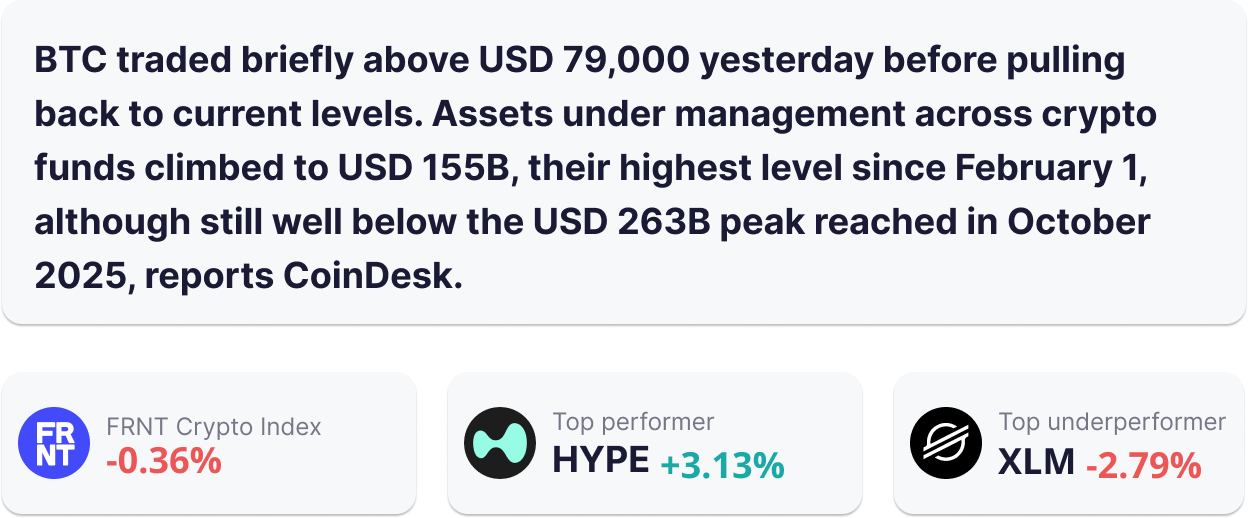

In the latest crypto security incident, the Litecoin (LTC) network suffered a denial-of-service attack over the weekend - We examine the incident & discuss LTC in this AM’s note
What happened? The weekend security incident caused a 13-block chain reorganization that reversed roughly 32 minutes of activity. According to public reporting, the attack combined two elements: a consensus bug that allowed an invalid transaction to slip through, and a denial-of-service attack aimed at miners who were operating updated software that would have caught the invalid transaction. This appears to have created a window in which miners running the older version of the software produced a chain containing invalid transactions, while miners that had installed the fix were temporarily taken offline. Once the denial-of-service pressure eased, the valid chain reasserted itself and the network reorganized to the valid chain, reversing the invalid activity. The Litecoin Foundation has not disclosed how much LTC was involved in the invalid transactions.
What is Litecoin? With a market cap of USD 4.27B, LTC is the 22nd largest cryptocurrency. Launched in 2011, Litecoin is one of the earliest cryptocurrency networks, created as a faster, lighter version of BTC, designed to enable low-cost, peer-to-peer digital payments. Some 15 years since LTC’s launch, its pitch to investors is likely much less clear compared to its inception. BTC has developed layer-2 solutions for low-cost peer-to-peer payments. Stablecoins have also emerged as a new payment method beyond just crypto while offering the relative price stability of the US dollar. Moreover, as the aforementioned security incident suggests, LTC is subject to significant technical risks. In this context, despite its seniority in the crypto world, LTC belongs to a cohort of digital assets with highly questionable market caps. While LTC has seen an ~81% correction from its 2021 record of USD 23.17B, the asset does continue to underscore the persistence of questionable market caps in the crypto space.
Crypto investors have proven willing to overlook technical risks: In 2020, we described how ETH Classic, which had a market cap of USD ~1B at the time, had suffered a spate of ‘51% attacks.’ The exploit, which involves gaining control of at least 50% of a network’s hash power, essentially means a blockchain stops acting as a record of truth. We wrote at the time, ‘it is nothing short of shocking that the price has not declined further in ETC.’ This observation has held true for a plethora of assets and security incidents. LTC, for instance, saw no discernible price reaction to the weekend’s event. Moreover, given the limited attention the event received on social media, and the lack of a DeFi ecosystem built on Litecoin, it’s unclear if the attack will garner in-depth analysis like the Kelp DAO exploit. This raises the prospect that Litecoin holders will never fully get a full picture of the incident nor its potential for occurring again in the future.
The crypto space remains characterized by novel security challenges: Recent weeks have seen several unique security incidents in the crypto space. Just the month, beyond the Kelp DAO incident, the Drift Protocol suffered a USD 286M hack and a fake Ledger Live app on Apple’s App Store resulted in the loss of USD 9.5M worth of assets. The LTC attack, whose extent remains unclear, is the latest incident this month underscoring the persistent novel security challenges in the crypto space.
CRYPTO HEADLINES
Aave has raised approximately USD 160M of the USD 200M needed to cover bad debt from the KelpDAO exploit. The recovery initiative, referred to as ‘DeFi United,’ is led by Aave service providers and focuses on recapitalizing rsETH. Major contributors include Mantle, Aave DAO, and Aave’s founder. - link - @CoinDesk
Strategy (NASDAQ: MSTR) has acquired 3,273 BTC for USD ~255M at USD ~77,906 per BTC. The firm holds 818,334 BTC acquired for USD ~61.81B with an average price per token of USD ~75,537. - link - @Saylor
Luxor Technology has committed USD 100M to purchase MicroBT WhatsMiner rigs and will expand support for WhatsMiner machines via its LuxOS firmware. MicroBT has signed a term sheet to invest in Luxor through Inflection Technology Ltd. The investment size is undisclosed. Luxor’s firmware currently runs on over 300,000 BTC mining rigs. - link - @TheBlock
Western Union (NYSE: WU) is expected to launch its USDPT stablecoin on Solana in June 2025 for agent settlements, with Anchorage Digital Bank as issuer. The company plans a USD Stable Card for consumer global stablecoin spending in dozens of markets later this year. Adjusted Q1 2026 revenue was USD 983M. - link - @Decrypt
KBank, the sole banking partner for Upbit, is collaborating with Ripple to test on-chain cross-border remittance using Ripple’s infrastructure. The proof-of-concept, involving wallet app testing and international transfers, has completed its first phase and is now evaluating stability in further trials. - link - @TheBlock
The EU has issued its largest Russia sanctions package in two years, imposing a total ban on Russian crypto providers, platforms, and the central bank digital ruble. The measures target 20 Russian banks, four linked foreign institutions, and the Kyrgyz exchange TengriCoin, while prohibiting EU residents from using Russian and Belarusian crypto platforms. - link - @CoinDesk
TOP ARTICLES
Bloomberg: Bitcoin’s Stealth Rally Has Traders Setting Sights on $80,000
WSJ: Trump’s Crypto Luncheon Draws ‘Superstars.’ But His Token Hovers Near Low.
Barron’s: Bitcoin Came So Close to Breaking $80,000. Why It Failed.
OPEN-SOURCE RESEARCH / LONG-READ OF THE DAY
Why DeFi isn’t dead despite massive exploits and $13 billion investor exodus, CoinDesk, April 26, 2026
CoinDesk argues that the DeFi sector will recover from the Kelp DAO hack over the long term.
CRYPTO MULTIMEDIA
How Arkham Tracked North Korea’s Lazarus Group After the KelpDAO Hack, Unchained, April 23, 2026
Miguel Morel, the CEO of blockchain analytics firm Arkham, ‘explains what digital fingerprints made it clear North Korea was the likely hacker.’
CHART OF THE DAY
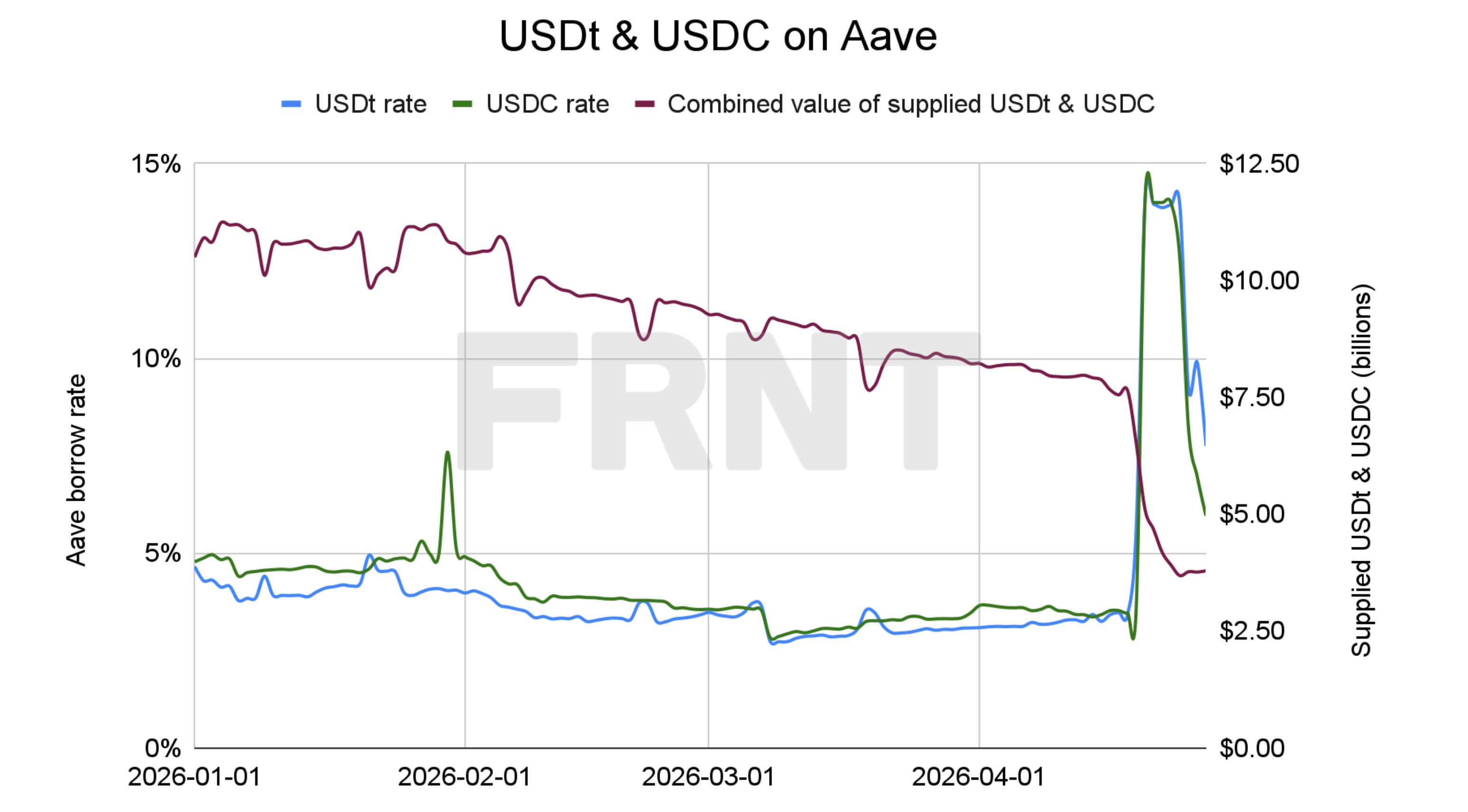
On Aave, USDt and USDC lending markets have begun to normalize. For both stablecoins, the cost to borrow has come down to ~6% after remaining at ~14% for days following the Kelp DAO hack.
About FRNT Financial
FRNT is a digital asset investment bank offering capital markets and advisory services to institutional investors participating in or entering the space. The Company aims to bridge the worlds of traditional and web-based finances with a technology forward and compliant operation. Business lines include deliverable trading services, structured derivative products, merchant banking, advisory, consulting, lending origination and principal investments. Headquartered in Toronto, FRNT was co-founded in 2018 by CEO Stéphane Ouellette.